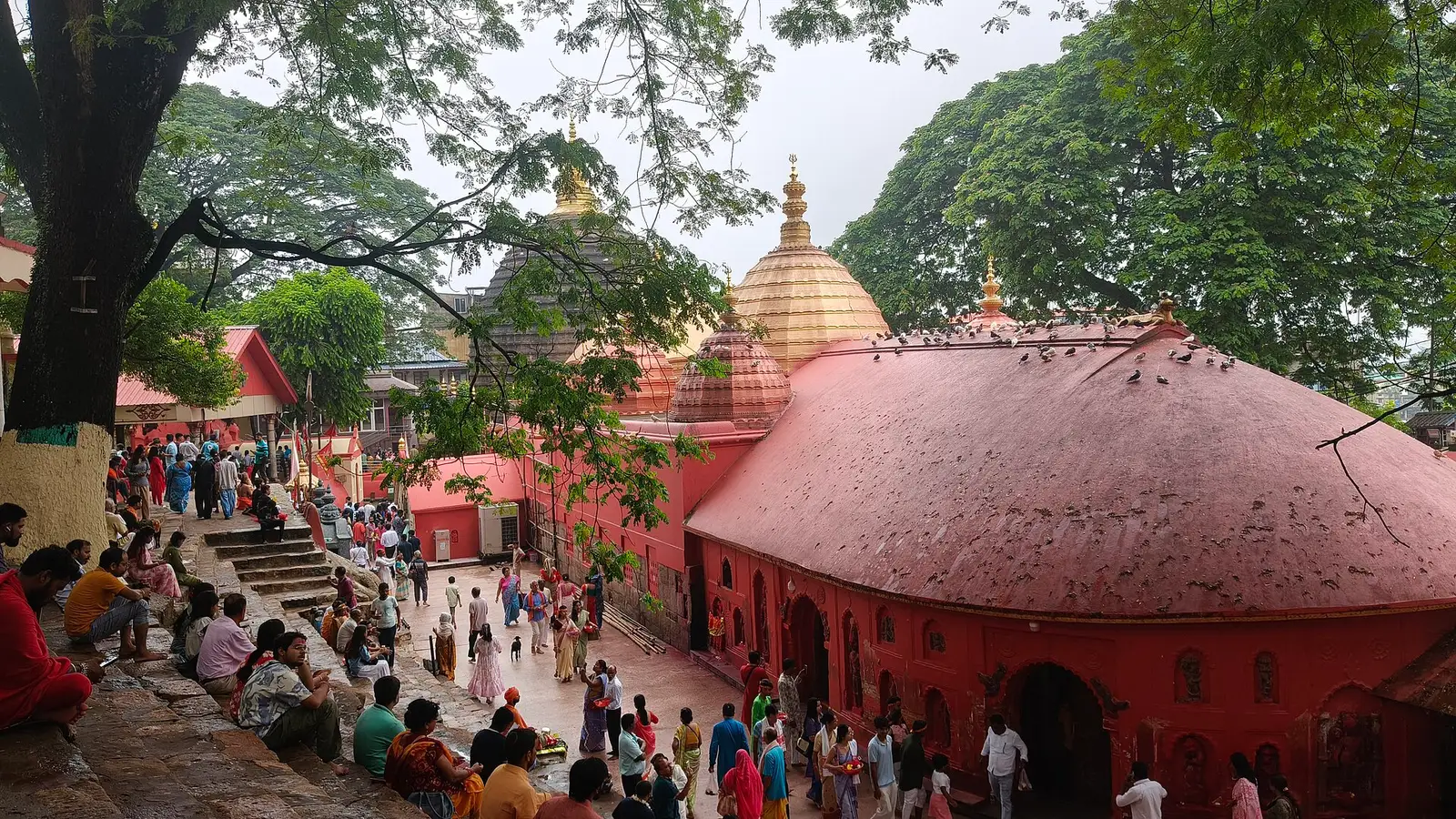
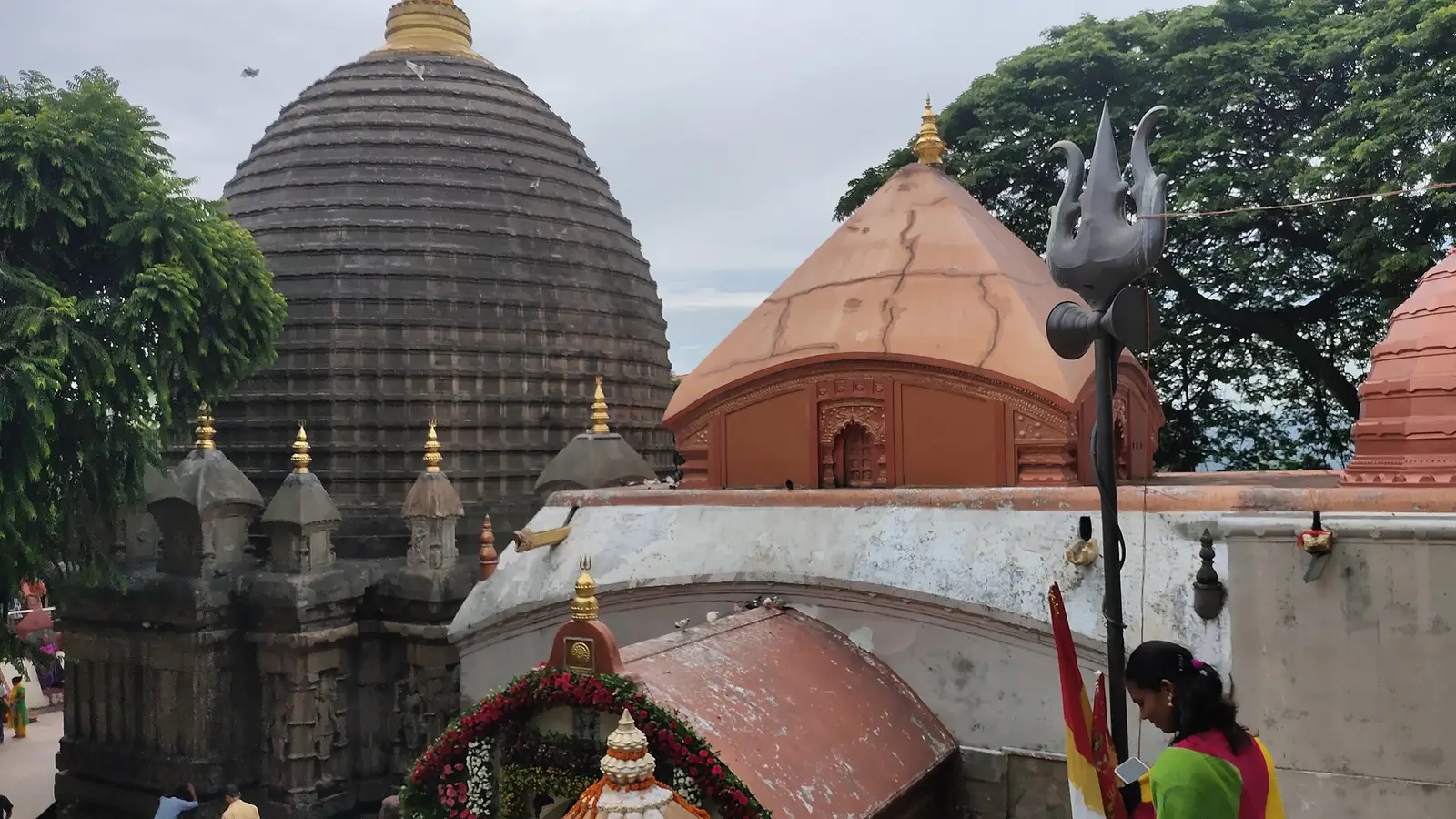
The temple of Maa Kamakhya on Nilachal Hill in western Guwahati is revered in Shakta tradition as one of the most important Shakti Peethas and as a great centre of Tantric worship. The Goddess is worshipped in the form of a yoni-shaped stone in a rock chamber fed by a natural spring. The present temple was rebuilt in 1565 under the Koch king Naranarayan.
About
Temple administration
Maa Kamakhya Devalaya describes Maa Kamakhya, or Kameswari, as the Goddess of Desire, and her shrine on Nilachal Hill as the most sacred of the Shakti Peethas and a centre of Shakta and Tantric traditions.
The Nilachal complex contains, besides the main shrine, temples associated with the ten Mahavidyas and several temples of Shiva. Tripura Sundari, Matangi and Kamala are worshipped within the main temple; the other Mahavidyas have their own shrines on the hill.
Kamakhya is unlike most Hindu temples: its sanctum holds no carved image. Pilgrims descend into a dim rock chamber where the Goddess is honoured at a natural stone kept moist by an underground spring. The beehive-shaped shikhara, the red of sindoor and hibiscus, and the hilltop setting above the Brahmaputra make it one of the most memorable pilgrimages in India.
History
Historical fact
An ancient site
Worship on Nilachal is old, and remains of earlier stone temples survive in the fabric and surroundings of the present shrine, but no founding date is known. Historians generally regard the site as having been a place of Goddess worship long before the present structure.
The present temple was rebuilt in 1565 during the reign of the Koch king Naranarayan, with the work overseen by his brother Chilarai. Inscriptions of the Koch rulers are found at the temple.
Traditional accounts attribute the destruction of the earlier temple in the sixteenth century to the general known as Kalapahar. Historians have questioned this attribution, and it is presented here only as tradition.
After the Koch period the Ahom kings patronised the temple, and further structures were added to the complex in the eighteenth century. Several of the other temples of Guwahati — including Ugratara and Navagraha — also date from Ahom royal patronage.
The temple is administered today by Maa Kamakhya Devalaya, whose office is headed by the Doloi. The Devalaya publishes the daily programme, festival calendar and notices on its official website.
According to Shakta tradition, when Sati gave up her life at the sacrifice of her father Daksha, Shiva wandered the universe carrying her body. Vishnu’s discus divided the body, and the places where its parts fell became the Shakti Peethas. Kamakhya is traditionally identified as the place where the yoni (womb) of Sati fell. The Kalika Purana and the Yogini Tantra are the principal texts associated with Kamakhya.
Shakti Peetha lists differ from text to text in their number and their places. Kamakhya is prominent in most of them.
Tradition also connects the name Kamakhya with Kama, the god of desire: burnt to ashes by Shiva’s gaze, Kama is said to have regained his form here, and the land came to be called Kamarupa. The Devalaya itself describes the Goddess as the Goddess of Desire.
Local tradition holds that the hill turned blue (nila) when the Goddess’s yoni fell here, giving Nilachal — “the blue mountain” — its name.
Architecture
Historical fact
The Nilachal type
The rebuilt temple gave its name to a regional style — the “Nilachal type” — whose rounded, beehive-like shikhara rises over a cruciform plan. Older carved stone elements from the earlier temple are set into the lower courses.
The temple has four chambers: the garbhagriha and three mandapas known locally as the calanta, the pancharatna and the natmandir. The natmandir is used for ritual performances such as the Deodhani dances at Manasa Puja.
The sanctum lies below ground level and is reached by steps. It contains no image: the Goddess is worshipped at a yoni-shaped cleft in the bedrock, over which water from a natural spring flows. Photography inside the sanctum is not permitted.
The yoni at Kamakhya is understood in Shakta tradition as a symbol of the Goddess’s creative power — the source of life, birth and the world itself. Devotees approach it as the Mother, not as an object of curiosity; this site describes it with the same respect.
Kamakhya has been a major centre of Shakta worship and of Tantric traditions for many centuries. In this context “Tantra” refers to a large body of ritual, philosophical and devotional literature and practice centred on the Goddess as Shakti. It is a serious religious tradition, and this site does not sensationalise it or describe esoteric rites.
The Devalaya lists the Dasamahavidya of Nilachal. Tripura Sundari, Matangi and Kamala are worshipped within this temple; the others have their own shrines on the hill.
Each day begins with the Snana (ritual bath) of the Pithasthana at 5:30 AM and the Nitya Puja at 6:00 AM, before the doors open to devotees. At midday the temple closes while cooked offerings (bhog) are made to the Goddess and then distributed to devotees. The doors close for the night in the late afternoon, and the Aarati of the Goddess follows in the evening.
Devotees commonly offer red hibiscus (japa) flowers, red cloth, sindoor and sweets. In keeping with long-standing Shakta practice at Kamakhya, animal sacrifice also forms part of traditional worship. We record this as a fact of the temple’s tradition, without comment.
General darshan is free and runs through a queue that can take several hours at busy times. The official website links a free online booking for the general queue.
A paid Special Darshan (₹501 per person, per the Devalaya’s 2026 notice) is booked online only, through the portal linked from the official website. A separate special entry exists for defence personnel. Special arrangements may be suspended during heavy rush such as Ambubachi.
Use only the portals linked from the official website. The Devalaya has cautioned that other websites and apps offering pujas in its name are not authorised.
Footwear is left outside; during festivals it may have to be left at camps on the approach road.
Verified from official source· checked 23 September 2026
Each June, by the temple’s tradition, the Goddess’s annual menstruation is observed: the doors close for three days and reopen on the fourth after a ritual bath. In 2026 the Devalaya’s notice gave the onset as 22 June at 9:26 PM, with the temple closed 23–25 June and reopened on 26 June.
Very High Crowd Expected
Ambubachi is one of the largest religious gatherings in eastern India. Please plan carefully:
Book accommodation early — hotels sell out weeks ahead.
Expect very long queues after the reopening.
Follow official instructions from the temple, police and district administration.
Direct flights from Delhi to Guwahati (GAU), then a cab to Nilachal Hill.
⏱ About 2.5 h flight · ≈ ₹4,500 – ₹11,000
train from Delhi
Rajdhani and other express trains from New Delhi to Guwahati or Kamakhya Junction.
⏱ About 27–36 h · ≈ ₹1,000 – ₹5,500
flight from Kolkata
Frequent flights from Kolkata to Guwahati.
⏱ About 1–1.5 h · ≈ ₹3,000 – ₹7,000
train from Kolkata
Express trains from Howrah and Sealdah to Guwahati or Kamakhya.
⏱ About 17–22 h · ≈ ₹600 – ₹3,500
car from Guwahati Airport (GAU)
Taxi or app cab to the temple.
⏱ About 40–60 min · ≈ ₹700 – ₹1,300
Local from Guwahati city
Shared taxi from Kamakhya Gate up the hill.
⏱ About 15 min from the foot of the hill · ≈ ₹20 – ₹60
Road access
A winding road climbs Nilachal Hill from the Maligaon / Kamakhya Gate side of Guwahati to the temple. Guwahati is connected by national highways to the rest of the North-East and, via Siliguri, to the rest of India. Traffic on the hill road is often restricted on festival days.
Local transport
Shared and reserved taxis from Kamakhya Gate at the foot of the hill
City buses to Kamakhya Gate
App-based cabs and auto-rickshaws, where available
A stepped footpath climbs from the foot of the hill for those who wish to walk
Guwahati has a wide range of hotels. There are also guesthouses near the temple and at the foot of Nilachal Hill. Book early for Ambubachi and Durga Puja.
Areas: Kamakhya and Nilachal Hill · Maligaon and Pandu · Paltan Bazaar (near Guwahati station) · Fancy Bazaar and Pan Bazaar
budget
₹700 – ₹1,500
per room / night (approx.)
standard
₹2,000 – ₹4,500
per room / night (approx.)
premium
₹5,000 – ₹15,000
per room / night (approx.)
Hotels fill weeks ahead of Ambubachi — book as early as possible.
Staying in the city and reaching Nilachal early in the morning is often easier than staying on the hill.
This website does not take accommodation bookings.
Estimated expenses
Approximate daily spend per person
Comfort level
Per person / day
budget
₹800 – ₹1,500
standard
₹2,000 – ₹4,000
premium
₹5,000 – ₹12,000
Excludes travel to Guwahati.
General darshan is free. Special Darshan is ₹501 per person per the Devalaya’s 2026 notice — check the official website for current arrangements.
All expenses are approximate estimates. Actual prices vary by travel date, season, availability, festival demand and individual choices.
A Shiva temple at the meeting of three streams, associated with the sage Vashishtha.
Visitor tips
Queues for general darshan can take several hours; arrive early, and allow extra time on weekends and festival days.
Use only the portals linked from the official website for darshan bookings. The Devalaya has cautioned that other websites and apps offering pujas in its name are not authorised.
Check the Ambubachi closure dates for your year — the temple is closed for three days.
Wear modest clothing. Footwear is left before entering the complex.
This website is independent and is not operated by any temple. We do not take bookings or donations on behalf of any temple.
Beware of Unauthorized Online Puja Services
The official Maa Kamakhya Devalaya website states that websites and apps offering online pujas in the temple’s name are not authorised by the temple authorities. Use only official temple channels for temple-authorised services.
A complete visitor guide: reaching Guwahati by train, flight and road, local transport to Nilachal Hill, darshan and special entry, hotels, budget and a suggested itinerary.
How to travel from Delhi to Maa Kamakhya Devalaya: direct flights to Guwahati, long-distance trains to Guwahati or Kamakhya Junction, the long road journey, and the last leg up Nilachal Hill. Durations and costs are approximate.
A suggested three-day plan: arrive and take darshan on day one; the Mahavidya shrines, Ugratara, Navagraha and the Brahmaputra on day two; a nearby pilgrimage or Guwahati sightseeing before you leave on day three. Edit it to suit your pace — your changes are saved in this browser.
Guwahati has many temples besides Kamakhya. This circuit links the ones we have verified: Ugratara, Navagraha, Umananda, Basistha and Sukreswar. Each destination was checked separately; none is presented as a Shakti Peetha unless a source says so.
A configurable circuit of Shakta temples in and around Guwahati, starting at Kamakhya. Only temples we have verified are included. Kamakhya is a Shakti Peetha in the major traditions; the other stops are Shakta temples, and where a source links one with the Shakti Peetha tradition we say so and present it as tradition.
Duration
4 days
Approx. per person
₹9,300 – ₹28,500
View yatra
Please verify important details with the official Maa Kamakhya Devalaya before travelling.